
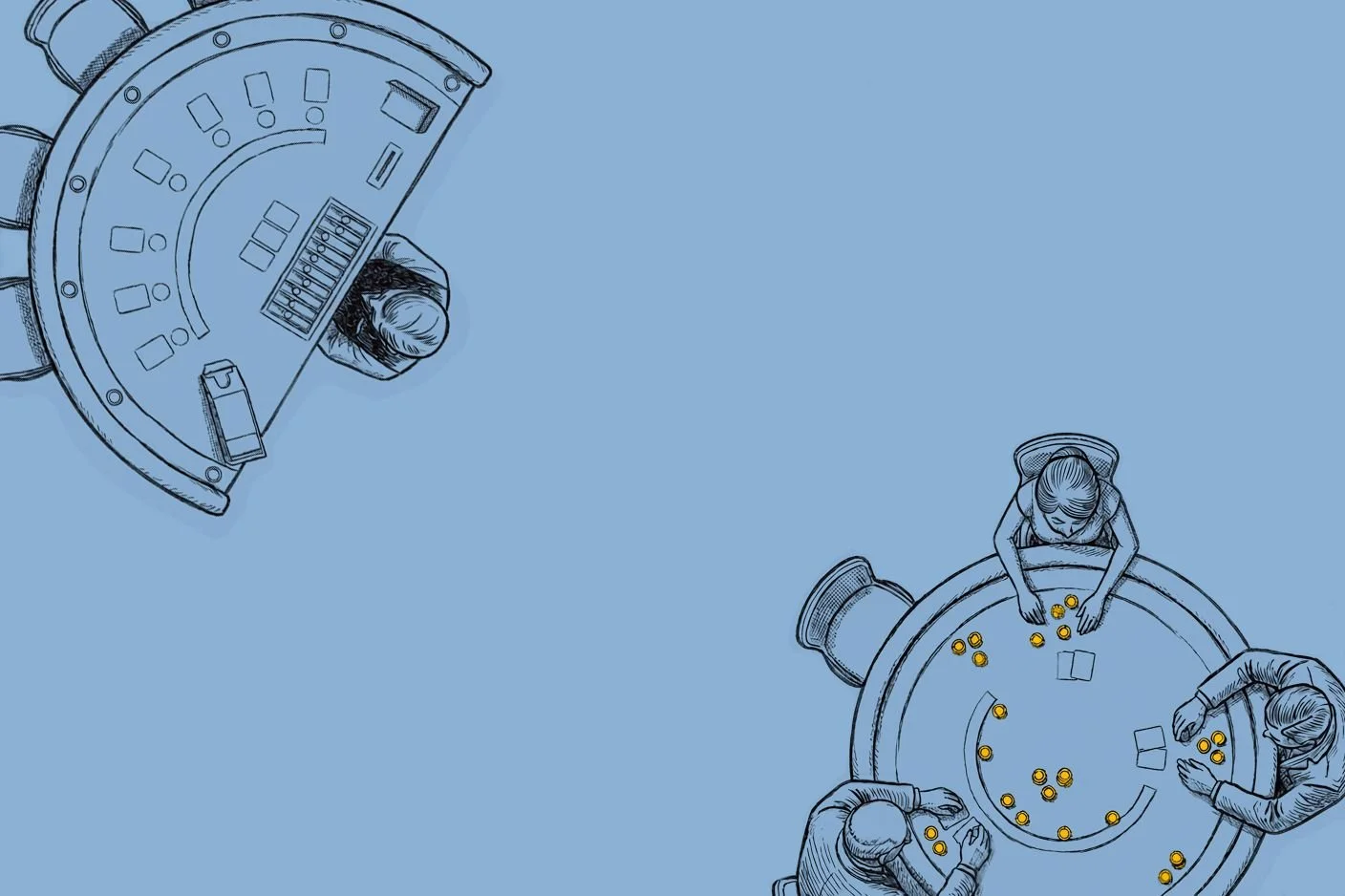
Investors love playing poker. Loads of investing luminaries have moonlighted in poker tournaments — David Einhorn, Steve Cohen. It works the other way too. Annie Duke started off as a poker player. Then she went on to have a lot to say about investing. There's plenty of overlap.
Poker and investing share high stakes, uncertain conditions, speed, the balance of playing your hand and playing your opponents. You can imagine walking into a room with Dave, Steve and Annie and seeing the wheels turning in their minds.
The dealer deals.
Steve gets a 2d and 5h. He folds.
David gets a Qc and 7h.
Annie ends up with a Jc and 9c.
The flop comes with a Qc, 8d and Th — a straight for Annie. She checks the turn — adding nothing to her bet — to avoid letting on she has a strong hand. Steve stays in, overplaying his pair and losing the hand and more money than he wanted because of Annie baiting him.
You think "Wow, I could really test myself against some of the sharpest degenerate gambling minds! I could learn a lot." Then you remember "oh, yeah, I'm playing with my real money… I wonder if there's an easier game?"
There's no extra credit for degree of difficulty. Then you go and sit down at a blackjack table.
Blackjack is a much simpler game. There's less skill required here. You're not playing your opponents, just the house. The dealer deals you a pair of 8s. You split the hand to double your chances of winning.
A new hand
Lamplighter last talked about Kalray in January. Kalray designs chips and networking solutions to use in specialty AI data centers. In late 2025 it signed its first customer for its new business strategy — OpenChip — a Spanish system-on-a-chip maker for exactly the specialty AI that suits Kalray. It was a good customer and a good contract. That helped shares scrape back from the abyss.
Management updated its 2025 progress late in April 2026. It played two new cards. It extended its partnership with OpenChip for another year and announced a new contract with a new customer.
How does that impact its value?
If the chip shop just repeats its performance with OpenChip on the renewed contract round, that adds around €12M in cash flow to the company. Its new contract will deliver at least €4.5M in cash flow over the next year or ~€7M over the lifetime of the contract. This contract also includes royalties on product sales. We're not giving credit for those yet.
So, that means they added ~€19M in value -- the amount they'll earn from the contracts — right?
Shares jumped by about €40M in value on the news. That's more than twice as much as the likely cash flow from the contracts. Why? What the contracts say about the business signals more about Kalray’s value than the particular contract terms. The contracts give two tells
OpenChip renewed. Repeat revenue is worth a lot more than one-off deals. The renewal shows Kalray is moving that direction.
A second contract increases the number of hands Kalray can play. Its potential pot of winnings rises and the pain from losing a customer lessens.
Know when to hold ‘em
These each have a bigger impact on value and hint at a potential bigger, broader market for Kalray's product. If it plays a successful game, a €40M increase in value by adding €19M in contractual profit will look like easy money. The biggest challenge for management is staying in the game.
Disclaimer: None of this is investment advice. It's meant to illustrate ways LCM thinks about investing. Things that LCM decides are good investments for LCM and its clients are based on many criteria, not all of which are covered here. Some or all of LCM's ideas may not be suitable for other investors. LCM does not recommend investing either long or short any position mentioned. LCM may own positions in some of the companies mentioned. Some of its ideas will lose money — investing entails risk. See full disclaimer here.